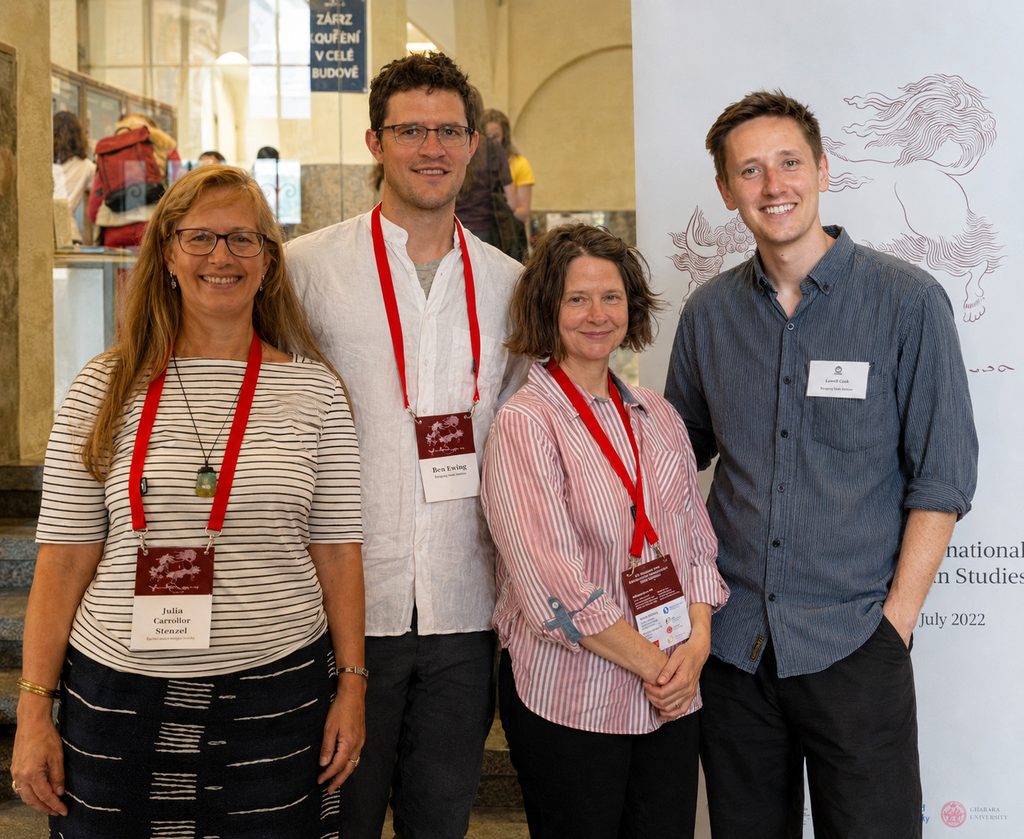
RYI Alumni translate Saraha’s Songs of Experience for 84000
The Subhāṣita Translation Group, consisting of four RYI alumni, namely Lara Braitstein, Benjamin Ewing, Lowell Cook, and Julia Stenzel, published their English translations of two works attributed to the Indian mahāsiddha Saraha for the “84000: Translating the Words of the Buddha.” The Consonant Dohā (Toh 2266) and The Written Explanation to the Consonant Dohā (Toh 2267).
The two texts are among twenty-four works attributed to Saraha in the Tengyur. Saraha is celebrated as one of the eighty-four mahāsiddhas and a lineage father of Mahamudra. He is remembered for songs with pithy and often hilariously cutting verses. Avoiding the high literary forms of kāvya belles-lettres, he chose instead dohā couplets and other meters, with their vernacular rhythms and earthy imagery, to convey his wisdom and esoteric teachings. He composed and chanted his songs around the 9th century, it is believed. His songs were transmitted orally for a while before being preserved as written text.
The Consonant Dohā, together with its commentary, gives poetic instructions on tantric practice in the form of an abecedarian or acrostic poem in which the first letters of successive lines or verses follow alphabetical order. Here the first letter of each of the four lines in a verse follows a version of the Sanskrit alphabet. The abecedarian form is rare in Tibetan literature, although for modern readers, they are relatively common in English children’s literature. Abecedarian poetry has a long history, from Hebrew psalms, Manichaean hymns, to a Gandhāri hymn of praise from the first or second century CE, written as an acrostic on the Arapacana syllabary, which is among the oldest Buddhist manuscripts discovered.
The translation project was carried out by the four co-authors between 2020 and 2022 under the auspices of 84000. The four enjoyed the challenging adventure of translating and researching Saraha’ poetry. Originally composed in Apabhraṃśa, they worked from the Tibetan text. The process involved many online meetings, a conference panel at the IATS 2022 in Prague, and the subsequent publication of an article, “S is for the Sound of the Yoginī” in the volume Studying the Bka’ ’gyur and Bstan ’gyur published by Brill. With the publication of both texts on 84000’s website, readers can now consult Saraha’s alphabetical teaching alongside its commentary, each with the translators’ introduction and notes.
Read the translations